
By: Manan Sharma

Gender and Jobtech in Africa
Women’s involvement and success on jobtech platforms presents a pathway to economic empowerment and better quality of life across sub-Saharan Africa. Globally, women are more actively engaged in online platform work than in the broader labor market, a 2023 World Bank survey found. But in sub-Saharan Africa, the picture is rather different — 27% of online platform workers are women, compared to 45% in the service sector — this is a growth and inclusion opportunity that needs harnessing.
To be able to change the status quo for good through digitally mediated work, there is a need for the ecosystem to be intentional in solving some inclusion barriers. We’ve previously conducted a Gender & Jobtech Landscape Scan to assess the barriers and opportunities for women in the jobtech space in Africa, some of which are highlighted below. This blog summarizes our Gender Strategy about how we’re taking action on that report.
High-level Jobtech Alliance Gender Strategy
Jobtech Alliance’s gender strategy recognises that creating an inclusive jobtech ecosystem happens in phases, starting with building a basic understanding & awareness about the gender in jobtech landscape, then undertaking acceleration activities focused on gender to demonstrate what is possible, while catalyzing responsive activities in the ecosystem to increase the level of inclusion, and encouraging transformative changes in the ecosystem to ensure equity.
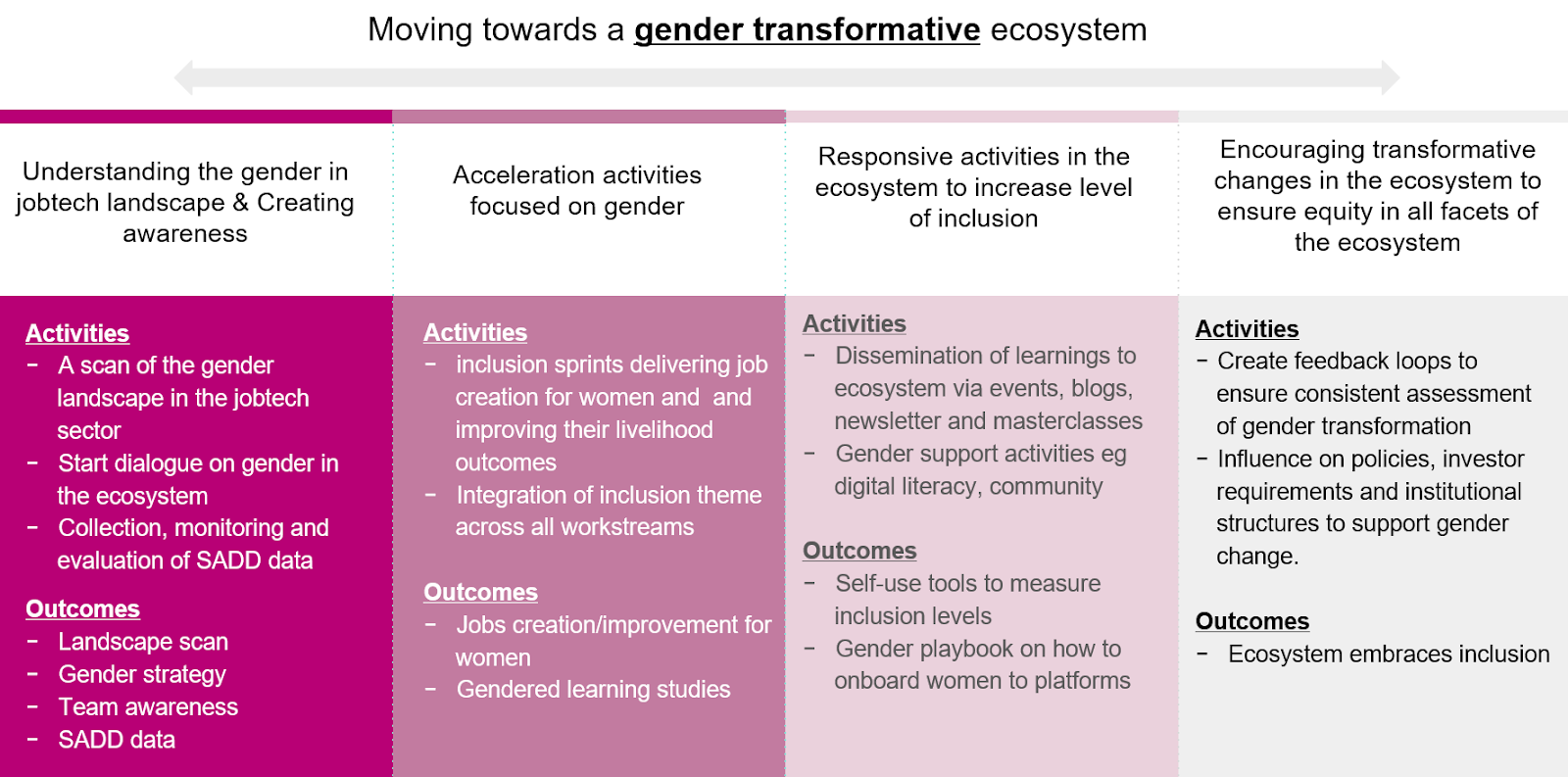
Our Gender Strategy involves us focusing on three workstreams:
1. Venture Support
In line with our high-level strategy highlighted above, we believe there is immense scope for furthering gender inclusivity across jobtech segments. But this requires focusing on sectors that have more opportunities for high female participation, helping platforms to overcome barriers in areas with historically low female participation, or responding to the unique opportunities or challenges that women face in different sectors. The real areas of opportunity come when examining at the category- or subcategory-level. Specific areas of interest include the following, but you can see the detailed breakdown in our gender strategy:

- Support the growth of platforms in women-dominated sub-sectors (esp. care services given higher payouts)
- Support women-focused platforms in sub-sectors where women’s representation has been low historically (such as delivery / logistics / ride hailing, which constitute of less than 5% women drivers) with special focus on delivery/logistics, given the sub sector offers a safer delivery option as well as higher women participation (as merchants)
- Undertake inclusion focused sprints to reduce access to barriers (finance, marketing, operations, etc.)
- Support integration of improved security measures on platforms (e.g., KYC, SOS, anti-harassment measures)

- Growth and inclusion support in sub sectors such as business process ourtsourcing/ managed services platforms which have significant opportunities for women
- Work towards anti-exploitative practices and encouraging fair-pay by working with platforms on transparent pricing and payment options, removing gender-bias in algorithms (Esp. for creative industries), etc.
- Create tailored training and development resources, including through integration of platform-led upskilling or production of open source e-learning courses on soft skills for women (e.g. negotiation skills, ensuring safety, etc.)
- Growth support for content creation in traditionally women dominated sectors

- Growth support for specifically social commerce / agent models (since models such as social commerce allow women to use their social capital and operate from any location, with limited / no upfront inventory costs)
- Support platforms that assist in expansion of sales and optimization of supply chain, especially those that work with a high percentage of women retailers (since women favor retail and often have existing businesses in the sector)
- Catalyze holistic onboarding processes that account for women’s challenges, needs, and aspirations (women often face onboarding issues due to lower levels of digital literacy or higher risk aversion)

- Facilitate collaboration between tech-enabled skilling platforms and other job-creating platforms to improve skills of female users, given cost of both cohort-based and self-paced learning can often be prohibitive for women
- Support platforms that encourage upskilling of women, especially in digital skills, given traditionally lower digital literacy for women

- Provide technical and research support for platforms which enable users to verify or use their professional identity, reputation and transactional data to improve livelihood outcomes, access benefits or similar services, especially given such benefits and financial accessibility can often prove elusive for even skilled women, who may not have professional history / resumes.
2. Enabling Environment
As Jobtech Alliance, we seek to create an enabling environment which provides the conditions for entrepreneurs to build platforms which deliver quality livelihoods. Mainstreaming gender across all of these workstreams is critical to ensure that we achieve female-focused outcomes on endpoint users through all this work. Our key work in this area in 2023-2026 includes:
- Research & Learning: Producing at least one gender-focused learning product every quarter
- Community Building: Regular online and in-person gender-themed events
- Catalyzing Funding: Bringing Gender Lens investors into the Jobtech Investment Network and ensuring that more funding goes to women-owned jobtech start-ups
- Standards & tools: Producing a gender inclusion checklist that platforms can use to measure their level of inclusion
3. Strategy, systems, team operations, and results measurement
Truly embedding gender into all our work means changing the way we work. We have also started working towards deeply integrating the gender lens into our systems, team operations, and results measurement processes:
- Strategy and Systems: Aim to draw out generalisable and actionable insights that support the Jobtech ecosystem to be intentionally inclusive of women
- Team Operations: Aim to integrate gender considerations in all Jobtech Alliance activities
- Results Measurement and Data: Aim to continually collect SADD and contextual data throughout platform lifecycle in the sprint and in the ecosystem
You can access the Jobtech Alliance’s full gender strategy, with detailed breakdown of workstreams, planned activities and objectives, and sector-specific opportunities, here.
The Author, Manan Sharma, is a venture building extern with Jobtech Alliance